Table of Contents
- Understanding the Meaning of “Father of Yoga”
- Who Is the Father of Yoga? A Clear Answer
- Sage Patanjali: The Mysterious Master
- The Yoga Sutras: Foundation of Classical Yoga
- The Eight Limbs of Yoga and Patanjali’s Legacy
- Father of Yoga Asanas: Clearing the Confusion
- Father of Ancient Yoga vs Father of Modern Yoga
- Patanjali’s Relevance in Today’s World
- Rishikesh: Living the Legacy of the Father of Yoga
- Spiritual Philosophy Behind Patanjali’s Yoga
- Conclusion
- Frequently Asked Question
Understanding the Meaning of “Father of Yoga”
When the father of yoga is what people search for, in their eyes there is a possible single origin point for an ancient practice. However, yoga was not born in a moment or from one person. It was a long process of thousands of years of Vedic hymns, Upanishadic philosophy, ascetic practices and sages lived experiences. Yet among all the contributors to yoga one does stand out for the clarity and simplicity in which he captured and preserved yogic knowledge.
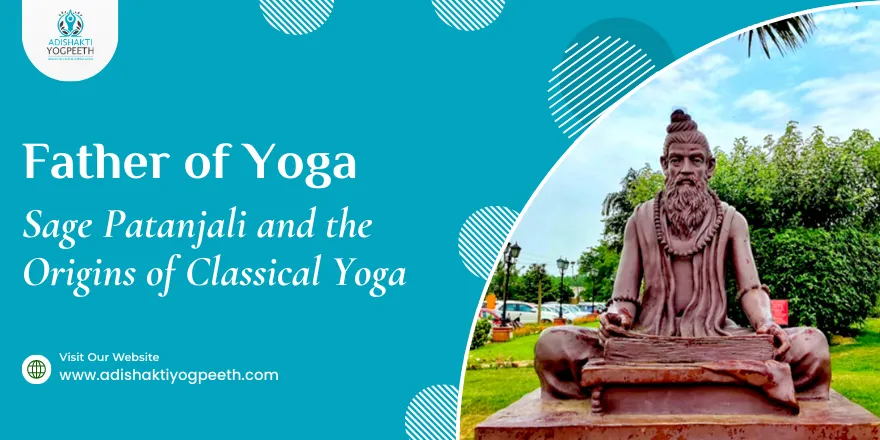
Sage Patanjali is regarded as founder of yoga as he compiled and systematized yogic teachings in the Yoga Sutras, which provides yoga a philosophical backbone. Without Patanjali, yoga may well have been scattered and kept alive only in oral traditions. His work permitted yoga to be taught, practiced, and handed down through the years.
So, when you hear someone say who is the father of yoga, it should be a no-brainer that it is Patanjali, not as the creator of yoga, but the one who gave it clearness, structure and relevance to the world.
Who Is the Father of Yoga? A Clear Answer
To get to the point: Patanjali is the father of yoga in the classical tradition. He is also known as the father of ancient yoga as his teachings maintained the core principles of yogic philosophy at a time when spiritual wisdom was mostly oral.
''Who is considered the father of yoga''? It is also widespread in hinduism and yoga teacher forums. In both cases, Patanjali is referred to with a deep reverence. He is significant not because he invented new techniques or practices, but because he has arranged the extant knowledge into an integrated system enabling one to achieve self-realization.
That is why Patanjali is the father not only of yoga asanas but also of right living, of pranayama, contemplating and spiritual regulation.
Sage Patanjali: The Mysterious Master
There is scarcely anything known about Sage Patajali's personal life. The dates are uncertain, and scholars place him anywhere between 200 BCE and 400 CE. However its influence can not be denied even with this uncertainty.
In the yogic tradition Patanjali is revered as a great sage from ancient times, who was half human and half serpent (naga), representing kundalini energy and boundless wisdom. As the story goes, he came down to earth to teach mankind to “overcome its suffering through yoga.
The enigma of his existence adds richness to his message. Patanjali never once mentioned biography or fame. Rather, he provided simple, effective methods for deep personal change. This is why the phrase ‘Patanjali, the father of yoga’ has an ageless, everlasting ring which is admired across the cultures and religions.
The Yoga Sutras: Foundation of Classical Yoga
The Yoga Sutras of Patanjali are made up of 196 brief verses spread over four chapters. These sutras make up the main reason why Patanjali is called the father of yoga.
The four chapters are:
Samadhi Pada – The meditation and consciousness section
Sadhana Pada – The Path of Practice and Discipline
Vibhuti Pada – Through yogic mastery the powers are obtained
Kaivalya Pada – The ultimate freedom of liberation and freedom
Each sutra is written in a terse style that is both very short to read but is also very profound to comprehend and this is why they require a guidance of a teacher for a complete understanding. Collectively, they depict yoga as a methodical process for transforming the mind from a state of obscurity to one of luminance.
The Eight Limbs of Yoga and Patanjali’s Legacy
One of Patanjali’s most significant achievements is the system of Ashtanga Yoga or Eight-Limbs of the Yoga. So what that means is a lot of people keep asking who is the father of ashtanga yoga or Patanjali is the father of ashtanga yoga.
These eight aspects are:
Yama (ethical bans)
Niyama (personal observances)
Asana (posture)
Pranayama (breath control)
Pratyahara (sensory withdrawal)
Dharana ( concentration)
Dhyana (meditation)
Summary (absorption or enlightenment)
This integrated approach makes it clear that yoga, as it were, certainly is not just about moving your body. Postures are just one aspect of a much bigger spiritual journey. Having this broader context enables students to practice yoga as a way of life and not just an exercise program.
Father of Yoga Asanas: Clearing the Confusion
Many contemporary teachers are father of yoga asanas question especially menagers yoga in fact.. Although Patanjali was not Camping many physical postures like we see in today’s studios, he established the spiritual framework that gave asana practice purpose.
In the Yoga Sutras, Patanjali describes asana as a position that is steady and comfortable. This simple definition truly focuses on awareness, alignment and being still as opposed to complicated. Eventually Patanjali’s guidance was overtaken by later yogic systems that expanded on the physical side of things, but he defined the beginning point: asanas are for meditation, not the other way round.
Therefore he is rightly regarded as the spiritual father of yoga asanas, however the asanas came later.
Father of Ancient Yoga vs Father of Modern Yoga
The question of what distinguishes the father of ancient yoga from the father of modern yoga is a very frequently asked one by students. Patanjali is often called the father of ancient or classical yoga. His teachings concentrate on freedom, discipline and the mind.
While it is believed that the father of modern yoga is Tirumalai Krishnamacharya. He also had a significant influence on modern yoga by popularizing its use to his students, such as B.K.S. Iyengar and Pattabhi Jois.
The question is: when they are asked who the father of modern yoga is, or who is the father of modern yoga, the answer is different to Patanjali. Yet even modern yoga has the depth of Patanjali embedded in it, so the two influences are not quite parallel but rather they intersect.
Patanjali’s Relevance in Today’s World
Although it is thousands of years old, the philosophy of Patanjali has applicability in today’s life. Worry, nervousness, mind wandering, and a sense of meaninglessness are experiences shared by human populations around the world. Through these teachings of self-restraint, vigilance, and equanimity, the Yoga Sutras deal with these afflictions.
In following the guidelines laid down by the father of yoga, people are able to master the mind rather than have it master them. That is perhaps why yoga therapy, mindfulness techniques and meditation courses on all continents still quote from the wisdom of Patanjali.
Rishikesh: Living the Legacy of the Father of Yoga
Rishikesh is considered as the yoga capital of the world and the spiritual vibe resonates with Patanjali's principles. Nestled in the lap of Himalayas along with the holy Ganga, this ancient town is the best place to let your soul experience the traditional yoga at its extremities.
Patanjali's teachings are followed not just in philosophy, but in rigorous practice, meditation, and ethics, at Adishaktiyogpeeth. Courses such as 100 Hour Yoga Teacher Training In Rishikesh intend to bring students into direct contact with traditional yogic teachings found in classical literature.
In a similar fashion, seekers interested in awakening their inner selves have the prospect of Kundalini Yoga Rishikesh, where the hidden energy themes expressed symbolically in pre-historic cultures are taken up with mindfulness and security.
For all those enthusiastic travelers in the pursuit a brief yet life-changing experience,a 5 Days Yoga Retreat In Rishikesh enables to be absorbed into the yogic lifestyle inspired by the timeless wisdom from the father of yoga.
Spiritual Philosophy Behind Patanjali’s Yoga
Patanjali’s yoga is very philosophical. It is rooted in Samkhya philosophy, which delineates the interplay between consciousness and matter. According to Patanjali, we suffer because we do not know who we are.
By means of practice and non-attachment, the mind-states can be stilled and one can abide in itself. This objective, named Kaivalya, signifies absolute liberation. For this reason Patanjali is considered as y the father of y oga both from the perspective of practice and from spiritual philosophy.
Conclusion
Sage Patanjali is not only a historical personage; he is expressed in every genuine yogic practice. When seekers pose the question, “Who is the father of yoga?”, they desire to know the source of wisdom that brings about inner freedom.
Patanjali’s teachings show us that yoga is self-realization, benevolence, and awareness of itself. Whether you take up asanas, meditation or breathwork, the core of yoga always leads back to the father of yoga, Sage Patanjali.
In honoring his legacy, and in the process of doing so, practitioners transcend the physical practice and enter into the very spirit of yoga - a passage toward oneness, lucidity, and freedom.
Frequently Asked Question
1. Who Is the Father of Yoga?
Sage Patanjali is the father of yoga because he brought together all yogic knowledge in a systemized form in the Yoga Sutras and provided a philosophical foundation for classical yoga practice/ spiritual self-realisation.
2. Why patanjali called as father of yoga?
Patanjali’s name is synonymous with classical yoga as in his time tested the ethical discipline, meditation and control of the mind and body which is the basis of the classical yoga followed across the world after centuries.
3. Who is the father of ashtanga yoga?
Sage Patanjali also known as the father of the ashtanga yoga system, who taught an eightfold path in the Yoga Sutras, which represents a comprehensive yogic lifestyle including moral behavior, physical yoga practice, concentration and enlightenment or moksha.
4. Was Patanjali the father of modern yoga?
The father of ancient yoga, Patanjali; and the father of modern yoga – who made the physical asanas popular – Tirumalai Krishnamacharya. Modern yoga still adheres to Patanjali’s philosophical tenets.
5. What makes Patanjali’s yoga so enduring?
Patanjali’s yoga is still applicable today, because it concerns itself with mind control, emotional stability and self-knowledge, and teaches us how to lead a balanced life and not get stressed, how to acquire clarity of mind and to lead a purposeful life in this chaotic modern world.