Table of Contents
- What Is Anulom Vilom Pranayama?
- The Science Behind Anulom Vilom Pranayama
- Anulom Vilom Pranayama Benefits
- How to Perform Anulom Vilom Pranayama: a Step by step guide
- Anulom Vilom Pranayama: Steps to Do, Benefits, and Precautions
- Anulom Vilom Pranayama and Nadi Shodhan: What is the Difference? Understanding The Distinction
- Anulom Vilom Pranayama for New Participants
- Why Learn Anulom Vilom at Adishakti Yogpeeth?
- Conclusion
- 5 Frequently Asked Questions (FAQs)
What Is Anulom Vilom Pranayama?
Anulom vilom is a breathing practice that brings breath in through one nostril and out through the other. "Anulom" signifies "with the grain" or "natural", and "Vilom" means "against the grain." Together, they reflect the equal flow of energy in the left and right sides of the human body.
It is also known as:
- Alternate nostril breathing
- Pranayama Anulom Vilom
- A preparatory technique for Nadi Shodhan
- A balancing pranayama that harmonizes Ida and Pingala nadis
This ancient yogic science is potent and deeply rooted in effective teachings that are taught all over the world, every yoga retreat and teacher training programs offers this practice because how profound it is for the body, mind and emotions.
The Science Behind Anulom Vilom Pranayama
There’s a whole hemisphere of the brain for every nostril, as they operate in different tones:
- Left nostril (Ida nadi): Cooling, calming, feminine energy
- Right nostril (Pingala nadi): Heating, active, masculine energy
Stress, emotional upheavals and our daily livelihood can cause these nadis to get imbalanced. Anulom Vilom Pranayama Anulom Vilom Pranayama is a technique in breathing education that involves adjusting breathing to maintain both nostrils in an equal mode of performance. It also helps in better oxygenation, lung function, nervous parasympathetic and overall Pranayama benefits like relaxation and higher energy.
Anulom Vilom Pranayama Benefits
The benefits of anulom vilom pranayama are for physical, mental emotional, and energetic bodies. Here is the detailed explanation which is beneficial for you:
1. Respiratory Health Improvement
Anulom Vilom increases the lung capacity and it also clears nasal passages which helps in better absorption of oxygen. Practice regularly supports:
- Mild asthma
- Nasal congestion
- Breathing issues related to allergens
- Stressinduced Breathlessness
The lungs are oxygenated equally and intensely when the nostrils are alternated; consequently, the efficiency of breathing increases.
2. Decreases Stress and Anxiety
Among the other popular advantages of anulom vilom pranayama is that it helps calm your nervous system. It triggers the parasympathetic system, reduces cortisol levels and relaxes you.
Benefits include:
- Reduced anxiety
- Mental clarity
- Emotional stability
- Better mood regulation
For students enrolling in training courses such as the 100 Hour Yoga Teacher Training in Rishikesh, this practice serves as a strong base for meditation.
3. Improves Attention and Awareness
Alternate nostril breathing increases concentration as it balances the two halves of the brain.It encourages:
- Clearer thought
- Better memory
- Heightened alertness
- Increased mindfulness in yoga and in life
4. Detoxifies the Body
Anulom Vilom helps in the cleaning of nadis (energy channels) and elevates circulation. This eliminates toxins, allows more energy to flow, and strengthens digestive power.
5. Emotional Support
When you practice regularly, it will help to let go of repressed feelings and will stop your mind from running wild. It is commonly referred to as in yoga therapy courses as:
- It stabilizes emotional swings
- Increased patience
- Reduces irritability
- Increases quality of sleep
6. Balances Hormone and Energy Systems
In doing so, the energy flow in the body becomes more stable. This also supports:
- Hormonal balance
- Improved metabolism
- Increased fertility
- Enhanced vitality
How to Perform Anulom Vilom Pranayama: a Step by step guide
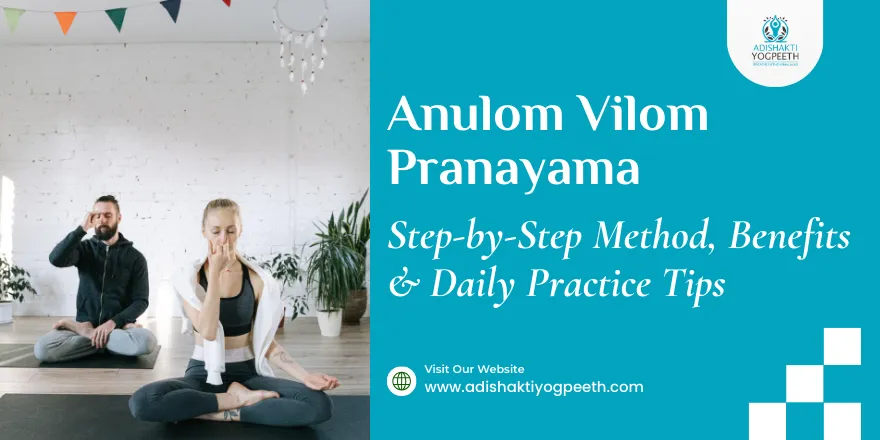
What is the right Anulom Vilom Pranayama steps for an effective and safe practice?Follow the complete anulom vilom pranayama steps:
Step 1: Sit comfortably
- Sit in Sukhasana, Padmasana or Vajrasana
- Keep your spine upright
- Relax your shoulders
- Close your eyes softly
Step 2: Make Nasika Mudra
With your right hand:
- Bend the index and middle fingers
- Have the thumb, ring finger and little finger active
This mudra also facilitates easy switching of nostrils.
Step 3: Start With the Left Nostril
- Use your right thumb to close your right nostril
- Breathe in slowly through your left nostril.
This starts the flowing of the cooling and soothing energy of Ida nadi.
Step 4: Change and Exhale from right nostril
- Unload the right nostril
- Shut your left nostril
- Breathe out through the right nostril
Step 5: Exhale from the Right Nostril (Alternate Nostril Breathing)
- Inhale slowly and deeply.
- Keep the left nostril closed
This potentates the hot, masculine energy of Pingala nadi.
Step 6: Air Out left nostril.
- Open the left nostril.
- Exhale fully
- This makes one full round.
Step 7: For the Next 5–10 Minutes, Hold On.
5 minutes, can be practiced by novice beginners. Gradually the duration of Anulom Vilom Pranayama to be increased as per the comfort level.
Anulom Vilom Pranayama: Steps to Do, Benefits, and Precautions
Performing this pranayama the right way is important to reap all its benefits and to prevent any kind of strain.
How to breathe correctly Step by Step
- Inhale → Left
- Breathe out →Right
- Breathe in →Right
- Exhale → Left
This sequence keeps the energies well balanced.
The main advantages at a glance
- Superior respiration health
- Increased concentration levels
- Less stress and anxiety
- Hormones in harmony
- Detox treatment
- Emotional well-being
Precautions you need to take
To prevent misuse, remember the following:
- Don't force the breath
- Keep the spine straight
- Do not practice immediately after meals
- Hypertensives should breathe slowly
- Pregnant women should not practice alone.
- If you get dizzy, stop right away
Always attend to your breathing with a qualified yoga teacher especially during courses as 100 Hour Yoga Teacher Training in Rishikesh is aware of this fact.
Anulom Vilom Pranayama and Nadi Shodhan: What is the Difference? Understanding The Distinction
However, there are two slightly different (but related) breathing practices confused by many practitioners:
Anulom Vilom Pranayama
- Alternating nostril breathing
- No breath hold
- Beginner friendly
- Calms the mind
Nadi Shodhan Pranayama
- Includes breath holding (kumbhaka) .
- Deep cleansing of the nadis Focuses on deep purification of nadis
- More advanced
- Generates influential energetic effects
While anulom vilom and nadi shodhan have the same procedures, Anulom Vilom is softer and better suited to those who are new to pranayama.
Anulom Vilom Pranayama for New Participants
If you're new to pranayama, here's how to get started safely:
- Begin practice with 5 minutes
- Make the breath natural and effortless
- Do not hold your breath.
- Practice on an empty stomach
- Maintain comfortable sitting posture .
- Gradually increase the duration
Yoga beginners who are undertaking formal studies such as a 100 Hour Yoga Teacher Training in Rishikesh, are introduced to Anulom Vilom in a controlled and phased manner by qualified.
Why Learn Anulom Vilom at Adishakti Yogpeeth?
Learning under the expert supervision allows you to be accurate, safe and gain more insight. At our school:
- Experienced instructors demonstrate breathwork in clear, easy step-by-step instruction
- You are taught the traditional theory of pranayama
- Daily practice hones your sensitivity
- You practice in a peaceful environment of Rishikesh
Regular classes or 100 Hour Yoga Teacher Training in Rishikesh - whatever your path - pranayama is a fundamental step in your yogic journey.
Conclusion
Anulom Vilom Pranayama is an eternal science of Yoga which balances and clears your entire system from within which further leads to calmness of mind. Its influences are felt on body, mind, and soul and hence it is a fundamental activity that every yogic system lays stress on. If done with care and regularly, it can bring revolutionary changes in your patterns of breathing, emotional stability and health overall.
Anulom Vilom and other practices are taught at Adishakti Yogpeeth in a traditional manner that acknowledges modern sensibilities so that you can access genuine benefits of Pranayama. If you’re just starting out on your yoga path or expanding your knowledge through programs such as 100 Hour Yoga Teacher Training in Rishikesh, this pranayama will continue to be an indispensable practice in your yogic journey.
5 Frequently Asked Questions (FAQs)
1. Is Anulom Vilom Pranayama suitable for beginners?
Yes. Anulom Vilom Pranayama is one of the most suitable breathing exercises for new learners as it is simple to learn and you don’t have to hold your breath in this breathing technique.
2. How much time should I take for Anulom Vilom daily?
Practice for 5–10 minutes initially and then extend it to 15–20 minutes according to your convenience. Consistency is more important than duration.
3. What are the key benefits of Anulom Vilom?
It increases lung capacity, reduces stress, calms the nervous system, increases concentration, purifies nadis, and promotes emotional stability.
4. Can I do Anulom Vilom after food?
No.It is to be practised empty stomach or after 3 hours of meal for better result.
5. Is Anulom Vilom Nadi Shodhan?
They are similar but not the same. Nadi Shodhan involves breath retention and a purer method whereas Anulom Vilom is simple normal alternate nostril breathing without holding the breath.